Signs of a foundation problem
Bowing or leaning basement walls
A basement wall holds back the ground. When the ground pushes harder than the wall can resist, the wall cracks along a line and starts to lean in. Caught early, there are several ways to hold it.
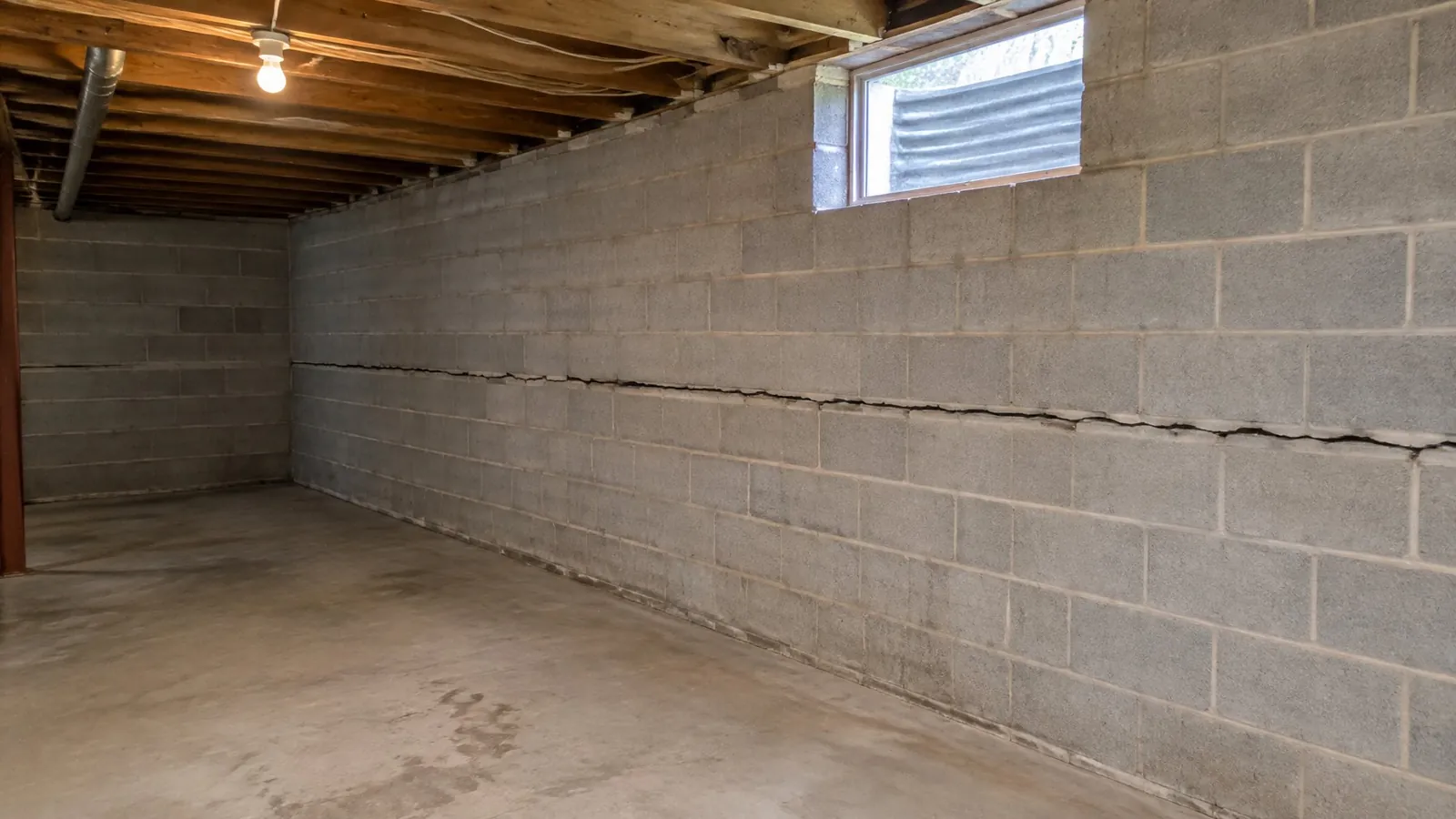
What it looks like
In a concrete block wall the first sign is usually a horizontal crack along a mortar joint, somewhere between knee and shoulder height, often with stair-step cracks running down toward the corners. Sight along the wall from one end: a bow shows as a belly in the middle. Hang a weighted string from the top of the wall and measure the gap at the crack and at the floor.
Poured concrete walls lean more than they belly. Look for a gap opening between the top of the wall and the framing that sits on it, or a diagonal crack at each end.
Why walls get pushed in Wichita
Clay-rich upland soils occur in eastern Sedgwick County. Changes in moisture can alter the pressure on a basement wall. An inspection considers that pressure alongside the wall design, drainage and any other source of movement.
The second is frost. The local building code sets the frost line at 24 inches below the surface and puts Sedgwick County in the severe weathering class for concrete and masonry. Saturated soil that freezes in the top two feet presses on the upper part of the wall, winter after winter.
Water makes both worse. A downspout that empties beside the wall, or a flowerbed that slopes toward the house, keeps that strip of soil wet.
What a company measures
- How far the wall has moved, in inches, at its worst point.
- Which course of block the crack follows.
- Whether the bottom course has slid inward on the floor slab.
- What is outside that wall: a driveway, a slope, a tree, a downspout.
- Whether the wall is still moving, which can mean fixing a gauge across the crack and reading it again after a season.
Ask for these numbers in the written report.
Ways a wall is held or straightened
- Carbon-fibre straps bonded to the inside face, for walls that have moved only a little.
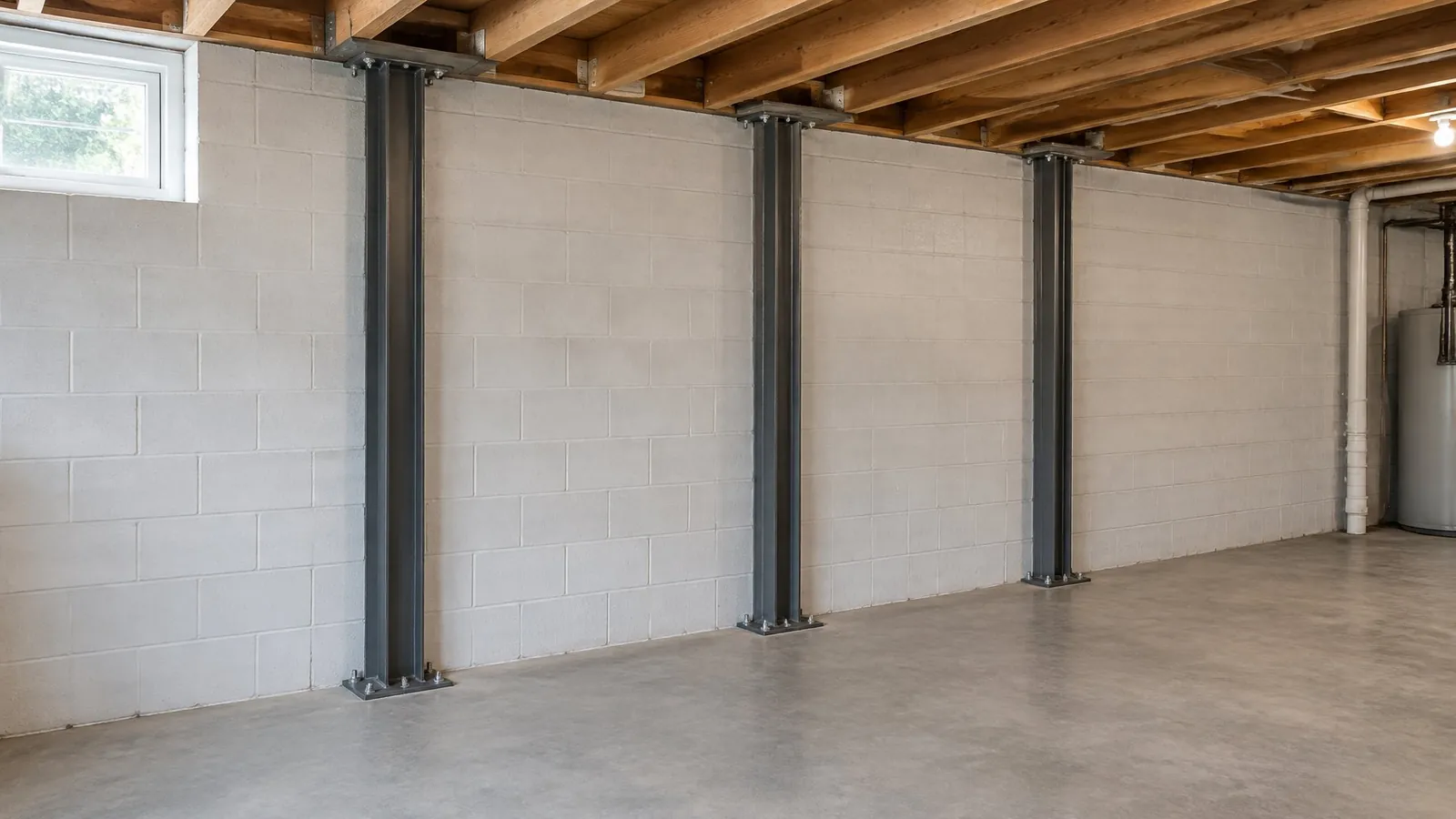
- Steel beams set upright against the wall, fixed at the floor and to the framing above.
- Wall anchors: a plate inside, a rod through the wall and an anchor buried in the yard. They need room outside.
- Helical tiebacks screwed out into the soil at an angle, where there is no room to dig.
- Digging out and rebuilding the wall, when it has moved too far for the others.
Some of these only stop further movement. Some can draw the wall back over time. Which one applies to your wall is something to have in writing.
If a wall moves suddenly
A wall that has shifted noticeably in a short time, blocks pushed out of line, new cracks with soil coming through, or cracking and popping sounds are reasons to get everyone out of the basement and away from that side of the house. Call 911 if you think the wall could give way.
If you smell gas, leave the house first and call 911 or the gas utility from outside. A call about repairs can wait until everyone is out.
Questions people ask
Can a bowed basement wall be pushed back straight?
Sometimes. Anchors and tiebacks can be tightened over months or years and may recover part of the bow. Beams and carbon-fibre generally hold a wall where it is. Digging out the soil and straightening or rebuilding is the direct route. Ask which outcome a proposal is aiming for.
Does bracing a basement wall need a permit in Wichita?
The local code requires a permit to alter or repair a building and a licensed contractor to do the work. Ask the company who applies for it. The permits guide has the details.
Ready to have it looked at?
Talk to a foundation repair company near Wichita
Call and describe what you are seeing. You will speak with an independent local company that can arrange to inspect the house and give you its findings and its price.
Foundation repair for houses
Basement walls, settling, cracks, crawl spaces and sloping floors in Wichita and nearby towns.
Call (316) 555-0119Calls may be recorded. See the referral disclosure and privacy policy.