Local guide
Why foundations move in Wichita
Wichita is flat enough to look uniform, but the ground under it changes from one side of town to the other. The soil your house stands on explains a good deal of what its foundation is doing.
West to east
Three kinds of ground under one city
Drawn from regional public sources and the Kansas Geological Survey's account of the county geology.
West side
Old river terraces
The Kansas Geological Survey describes older terrace deposits beside the Arkansas River valley. A house on a terrace can have different ground from one on the modern flood plain. Ask what soil and any placed fill were found beneath the actual footing.
The river valley
Sand and silt
The Arkansas and Little Arkansas river valleys contain sand, gravel, silt and clay deposits. The Kansas Geological Survey describes much of the flat land beside the Arkansas as poorly drained. Report past water entry and changes in sump activity; a valley location does not establish the soil beneath one house.
East and northeast
Clay over shale
Eastern Sedgwick County has upland soils with clay-rich subsoil, described in the county hazard plan. The Kansas Geological Survey identifies the Wellington Formation, including shale, limestone and gypsum. Andover also warns homeowners about expansive clay. Record seasonal changes without assuming that soil is the cause.
You can look up the soil mapped on your own lot with the USDA's Web Soil Survey. It is a planning map. A soil test at the site is what an engineer would rely on.
Clay that swells and shrinks
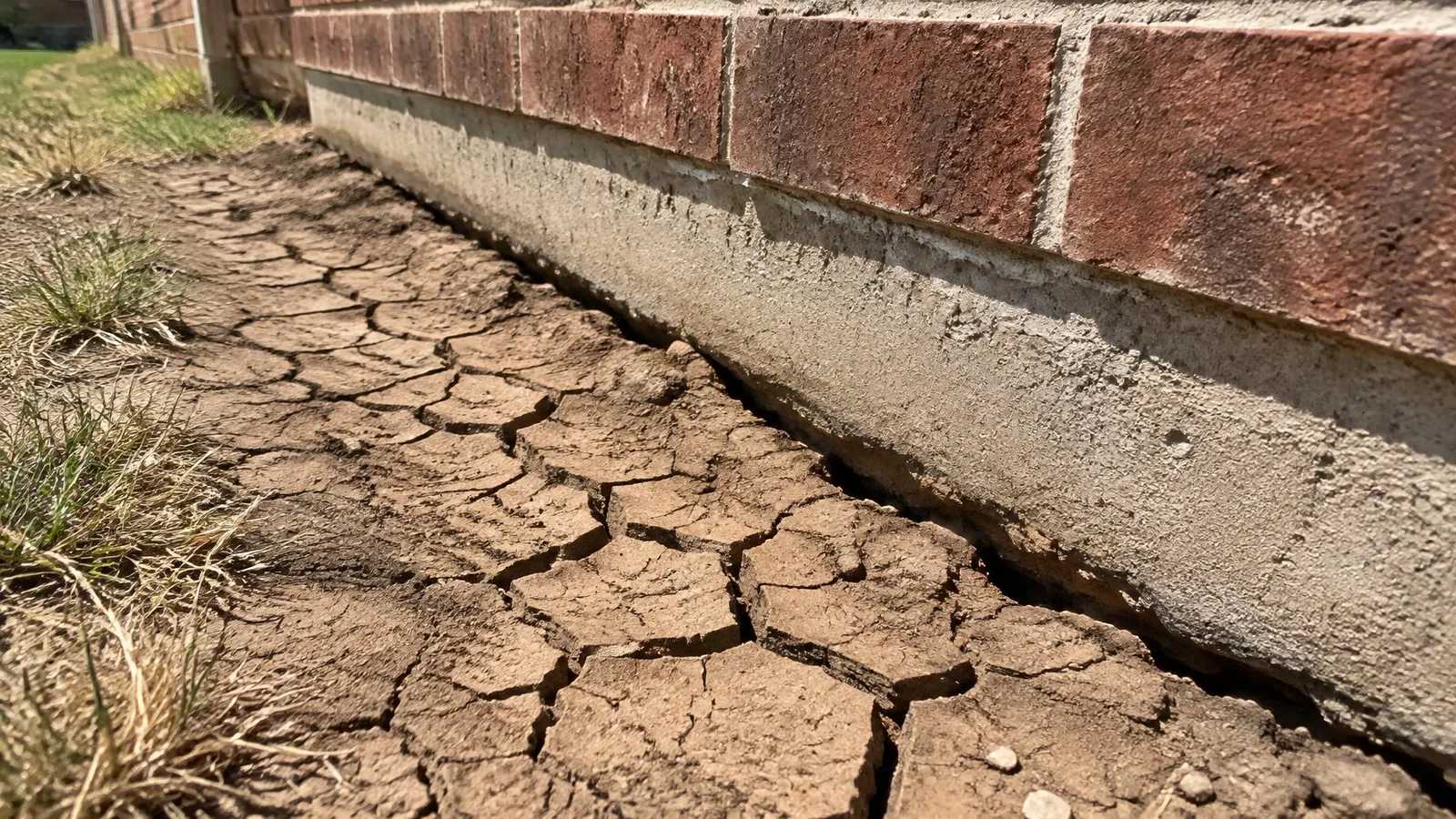
Clay takes up water and gets bigger; it dries and gets smaller. Under a house that happens unevenly. The soil beneath the middle of the house stays at a steady moisture, while the soil around the edge follows the weather, wet in a stormy May and dry by late August. A footing at the edge rides up and down with it, and over the years the corners that travel furthest crack first.
You can watch the same thing in the yard. In a dry summer, clay pulls back and leaves a gap along the foundation.
Wichita and Sedgwick County have written their own foundation, basement and slab standards for houses, and the local building code has a section on building on expansive soil. The people who review house plans here know the problem well.
Frost and a hard winter
The same code sets the frost line at 24 inches and rates Sedgwick County severe for the weathering of concrete and masonry. Footings are meant to sit below that depth so that freezing soil cannot lift them. Porches, steps, older additions and detached garages are the parts most likely to have been built shallower, and they move with the frost.
Along a basement wall, wet soil that freezes in the top two feet pushes inward. That is one reason horizontal cracks tend to appear in the upper half of block walls.
Water, in bursts
The Geological Survey's geography of the county says most precipitation falls during the growing season as brief, heavy thunderstorms. A dry spell followed by a night of hard rain is the toughest pattern for clay: it shrinks, cracks open, then takes water deep and fast.
In the valley, groundwater and drainage also need checking. Report water entry and changes in sump use. Regional descriptions cannot tell you the water level under a particular floor; the inspector must assess the site.
What this means for your house
Basement on east-side clay
Watch the walls. Horizontal cracks and an inward lean are the typical trouble, along with corners that drop in dry years. See bowing basement walls.
Basement or slab in the valley
Watch for water more than for cracks: damp walls, a busy sump, a floor that lifts. Sand does not swell, so movement here usually has another cause. See water by the house.
Floor over a crawl space
Watch the floors. Shallow pads move with moisture and frost, and damp wood weakens. See crawl space repair.
Newer house at the edge of town
A new house on upland clay can show its first cracks within a few seasons. Note each one with a date and keep the builder's papers.
Ready to have it looked at?
Talk to a foundation repair company near Wichita
Call and describe what you are seeing. You will speak with an independent local company that can arrange to inspect the house and give you its findings and its price.
Foundation repair for houses
Basement walls, settling, cracks, crawl spaces and sloping floors in Wichita and nearby towns.
Call (316) 555-0119Calls may be recorded. See the referral disclosure and privacy policy.